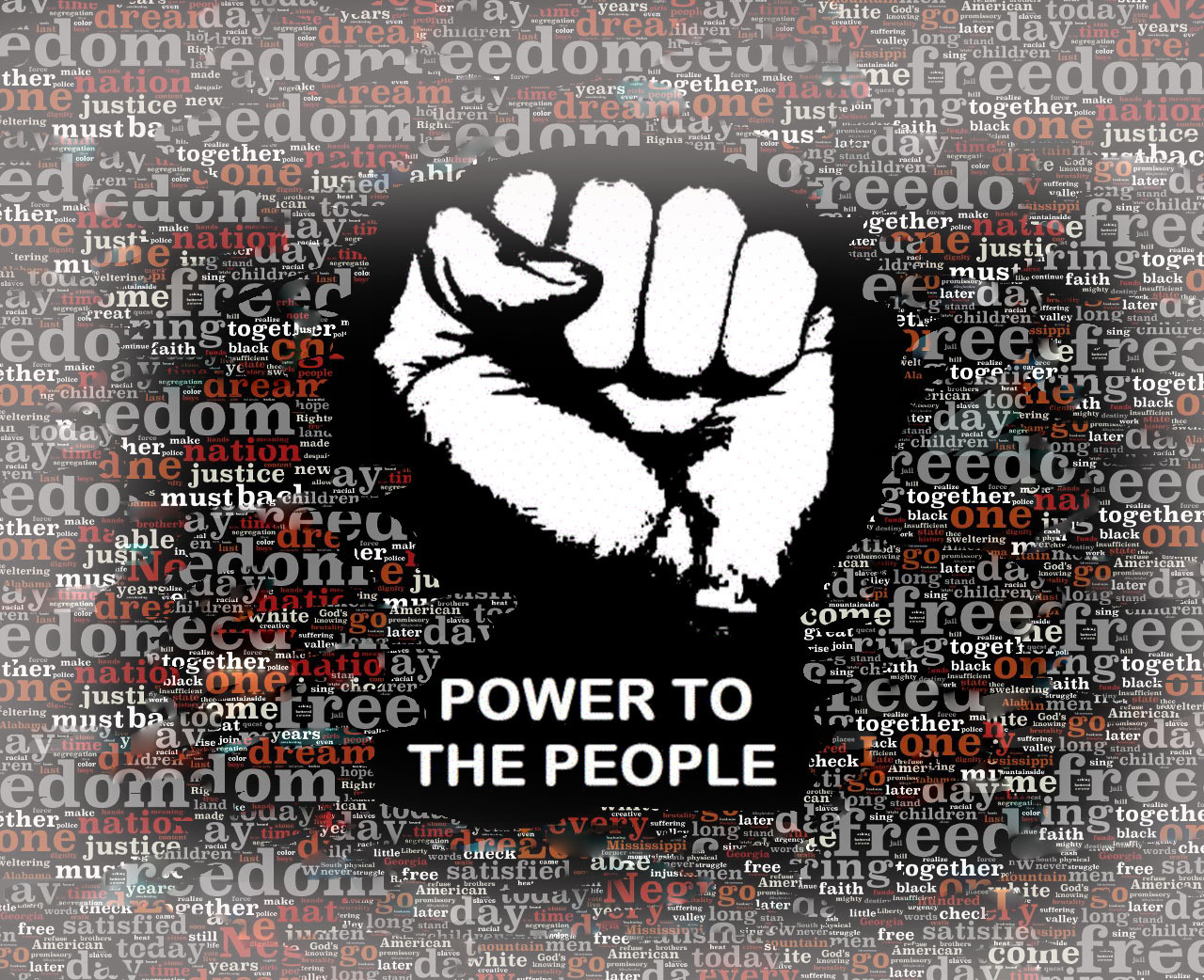
Category: Culture

In Post-11/8 America What is Your Personal Call to Action?

Let’s talk about the word “peaceful” because I’m getting fuckin tired of hearing about “peaceful protest.” | D. Firestein Protest, by its very nature cannot be peaceful. It is an attempt to upset the order of things (sometimes a weak attempt,...

 “A person in a state of dread lives in a miserable forever present. A person in a state of dread is imminently controllable. The choice to protest, on the other hand, is the choice to take control of one’s body, one’s time, and one’s words, and in doing so to reclaim the ability to see a future.”

Masha Gessen

In my state of dread over the election of DJT*, I keep coming back to one very germane fact: The majority of the American people (54%) did not vote for him. And I presume a sizable chunk of his voters, pulled that lever begrudgingly.

*I can’t bring myself to name him, especially as President. I’m looking for a workable alternative. So far I’ve considered: Trumplisconi, Mr. Minority President Trump, President 46% Trump, Mr. Unpopular President Trump, Abnormal President Trump, or just President Donny J (which, to tell the truth, sounds about right because it conveys his core identity as a celebrity and affords him about as much respect as he’s given the Office of the President so far). I welcome your votes or other suggestions.

So “we who are repelled by the person of DJT,” are in the majority. We need to use our voices. Each one of us needs to find ways to act, which likely means going outside of our comfort zones in one way or another, to save our democracy and ourselves. That sounds corny and hyperbolic – words I never thought I’d say. Sadly, there’s no corn, just these truths which are self-evident:

After 18 months of spewing vile and divisive rhetoric against women, minorities, Muslims, people with disabilities, etc., and exhibiting not one iota of interest in learning or preparing to be president, DJT starts his relationship with the American people in deficit — a deficit in trust, in integrity, in mutual respect, in competence, and in leadership. Since being elected, he’s done virtually nothing to lessen these deficits, nothing to unify the country (in fact, if anything he’s doubling down on the divisiveness, taking a victory lap so he can gobble up the leftovers and lick the plate of rapt adoration that endlessly gushes from his peeps). Unless and until he starts singing a different tune, we don’t owe him “a chance.” We don’t owe him respect. We don’t owe him a damn thing. Rather, he owes us, bigly.

Since being elected, DJT’s initial actions signal autocratic and regressive “code reds” on multiple fronts —

  • Vast and disturbing conflicts of interest he refuses to address meaningfully
  • A cabinet full of unqualified hacks that collectively signals intent to ravage our social safety net and civil rights protections, bolster our billionaire class, and abandon the survival of our planet
  • Steve Bannon as Chief Strategist — a dangerous propagandist, malefactor and chaos-sower who has enabled a cornucopia of hate movements — or for short, a vile human being
  • Ignorance, arrogance or both with regard to international relations as revealed by his casual, uninformed and strategically dangerous calls with world leaders
  • A clear effort to disregard, if not dismantle the capacity of the press to fulfill its role as the ultimate arbiter of the truth.  For example, he has held no press conferences, and I suspect never plans to do so. Not to mention no traveling press corps.

DJT, together with Republican establishment that now controls all of Congress and most of the statehouses, has at his disposal all the levers of government to advance whatever interests he so chooses. And he has shown us what those interests are: His businesses and personal wealth, his popularity, and his taste for revenge. Further, he has shown his willingness to cross lines, violate norms, and disregard our democratic institutions and values to serve those interests.

DJT has secured the presidency not for the country, but for himself. And the extreme Right have burrowed in, like a parasite to a host, aiming to thrive.

Like most people, I’m still sorting all of this out. But for now, until such time that this new president acts to address the deep deficits he’s amassed with the American people, and the far right is defanged, I intend to trade my dread for protest.

For my personal call to action, I commit to:

  1. Starving Donny J (name seems fitting here) of popularity, depriving him –and the corporate “entertainment” media who nourish him with unearned airtime in lieu of real news — of my eyeballs, ears, clicks,  attention or affirmation of any kind. I will not watch the inauguration.  I will boycott all things “Trump” — his hotels, his wife’s and daughter’s merchandise.
  2. Seeking actual truth by being a hyper-discerning consumer of information and news.  I will limit my intake to the very few print/online/broadcast sources and journalists who have demonstrated fidelity to the truth, ability to resist false equivalencies, and journalistic integrity.
  3. Engaging more fully and directly in our representative democracy to promote issues of importance to me.   I will contact my elected officials frequently, for example to demand hearings on DJT’s conflicts of interest and condemnation of Bannon’s role in this administration.  I will actively engage in the 2018 midterm and statewide elections, to begin to right the ship .  And I will participate in organized forms of protest in support of key issues of importance to me.
  4. Supporting and engaging more deeply with advocacy organizations that advance major causes of greatest importance to me. My personal priorities would include those focused on climate change, voting rights, reproductive rights, and civil rights.
  5. Acting with kindness and inclusiveness in my everyday life, and if necessary providing protection to those most vulnerable and marginalized by this new administration.

Those are my marching orders. What are yours?


Seeking an Education on Race in America

MLK

I originally wrote and posted this two years ago.  What I felt then, I feel even more now, so I’m re-posting it. 

Just as the Ferguson Grand Jury announcement was coming out, I happened to be reading a passage in Rising Tide (an incredible and superbly written piece of American history by John M. Barry – more on that later) that was eerily familiar.  The passage takes place in Greenville, Mississippi just after the Great Flood of 1927 which left the entire Mississippi delta, including Greenville, devastated.  Blacks were being forced to carry out the bulk of the relief and rehabilitation work, for no pay.  One morning a policeman named James Mosely had been assigned to assemble a work crew, when he saw James Gooden, a well-respected black man in the community who had just returned from working all night, sitting on his front porch:

“Nigger, you’re going to work.

No, Suh.  No Suh. I just been workin’.

Nigger, don’t give no backtalk.

No Suh, I’m not backtalkin’ you.

Gooden got up from the porch, went inside his house, and closed the door.  Mosely followed him into this home and pulled his gun.  Gooden froze.

Nigger! Get your black ass in that truck.

White man.  Don’t pull no gun on me!

According to Mosely, Gooden grabbed for the gun.  Mosely shot him.  But Gooden told a different version to blacks who carried him to the hospital.  In an effort to save his life, two white doctors amputated his arm. James Gooden died anyway.

The news swept through the black community.  Seething, blacks stopped work . . . Rhodes Wasson recalled, ‘We prepared for a race riot here. . . We thought the blacks were going to uprise.  Everyone was buying guns.’

To calm the Negro community, Mosely was arrested, supposedly to be held for trial.  No one believed that would ever happen.  The county prosecutor was still Ray Toombs, the Exalted Cyclops of the local Klan. (Mosely never was indicted).”

That was almost 90 years ago.

This book, together with several other sources I have recently consumed, have taught me a lot about many things American.  But mostly they’ve taught me one essential thing about myself:  That I (baby boomer white person who considers herself to be relatively enlightened) still have a great deal to learn about the basic truths of the black experience in America, both historic and present.  As a result, I’m now in active search of my education on the subject.  Not to be too preachy, but I think every white person needs to undertake this search, because most of us simply do not know what African Americans know about this history, nor do we know what African Americans know about justice — and so we operate from a different set of truths.  Neither have most of us taken the time to cultivate any real personal insight into the racial biases we almost certainly harbor, though often unintentionally.

By the way, for inspiration, we can look to the young people in our lives.  Their hearts and minds are in most cases still wide open; seeking truth and justice unencumbered by calcified biases.  They will, I think, pull our society forward and through and eventually out of this mess.

So in the interest of sharing, I thought I might recommend a few sources that have contributed significantly to my own enlightenment on the subject, with direct implications for understanding the present tensions and debate surrounding Michael Brown, Eric Garner, Tamir Rice, and many others.

Rising Tide.  This is the story of the efforts to tame and commercialize the Mississippi river in the 19th and early 20th centuries, culminating in the Great Flood of 1927 (about which Randy Newman wrote the song “Louisiana”).  There’s so much in this book about America, about our politics, our identity, and our culture, and so many lessons for today.  But front and center throughout, is the African American story in the deep south.   The factual accounting of events, their description in full detail and context, has been eye-opening, even shocking to me.  As you wind your way through this text, its rich description of the nature and depth of oppression and violence against blacks, is breathtaking.  It is a story that needs to be told in American history classes and taken up in adult book clubs around the country, but to my knowledge for the most part, is not.  I thank my brother for recommending this to me.

The Case for Reparations.  This article by Ta-Nehesi Coates appeared in The Atlantic recently, and carries the African American story forward to more recent history and present day.  It describes how blacks who fled the oppression of the south in search of work and greater justice in the north, encountered a different kind of shackle that appeared in the form of rampant, intentional, government-sanctioned housing and mortgage discrimination.  Coates explains how those practices directly and significantly diminished the wealth of African American families, a legacy that lives on today — having gutted their ability to earn equity in the one asset that is the single biggest source of wealth for most Americans – our homes.  Again, here is an article that deals in details and facts that remain largely unknown (or at the very least, not fully appreciated) by many of us, but which provide critical context for the current debate.

The Central Park Five.  This is the Ken Burns documentary about the 1980’s brutal rape of a white jogger in Central Park.  I’m embarrassed to say that this story was in many ways, news to me – not the crime itself (which I remember very well) – but the truth – which I don’t remember with the same clarity and resonance.  The truth is that the young boys (four black and one of Hispanic descent) who were accused and convicted of this storied crime, were completely innocent. The truth, which came out in 2002, is that the police and prosecutor wielded the full force of their phenomenal state powers against these children (the youngest was 14 years old), to extract false confessions that were entirely constructed by the police.

Why don’t I recall the truth as clearly as I recall the crime and the alleged guilt of the accused?  Because the guilt was captured on videotape — compelling images of young black boys admitting to a brutal crime — seared into the collective memories of millions of Americans like me.  And, if I’m completely honest with myself, it’s probably also because the guilt expressed on those videotapes fit perfectly well with pre-seeded biases I may have harbored, if even just subconsciously.   Those are the ingredients for a memorable story with impact . . . a story that people believe.

The truth on the other hand – that these boys were innocent – communicated as it was in a few newspaper headlines and articles, just didn’t break through in the same way, largely because it lacked compelling images to drive home the message.  And perhaps, just perhaps, it didn’t resonate because it was a story we weren’t too interested in hearing. But thanks to the brilliant Ken Burns, we now have a full account and countervailing images that can compete with the original false ones that were occupying our brains.  We can now more fully know the truth of this deeply disturbing miscarriage of justice, and can appreciate some of what African Americans know and feel when it comes to law enforcement and expectations for justice in this country.  After all, this took place not in early 20th century Mississippi – but in 1980s New York City.   And we know that this kind of raw, law-defying, racial injustice does not live in isolation, but is repeated in kind, throughout our country, as it has been throughout our history.

Note:  Fruitvale Station is another film that speaks to many of these same issues.  It is a dramatization of the story surrounding the shooting death of Oscar Grant by a BART police officer in Oakland, California. In the interest of wrapping up, I’ll leave this as a simple recommendation.  You can also read about it here

It is impossible, and irresponsible to talk about Michael Brown or Eric Garner and others, outside of this broader context.  Given historical fact and the present day, lived experience of African Americans, there can be no true finding of fact, or faith in justice served, so long as the too-familiar trappings of injustice pervade, as they do in these cases – the racial disparities between law enforcement and the communities they serve, the disrespect shown by law enforcement toward African Americans, or the failure of white prosecutors to exercise their prosecutorial function with the same vigor that they bring to other cases (after all, if they can “indict a ham sandwich” as the saying goes, why can’t they indict officers who shoot unarmed teens or whose crimes are clearly captured on videotape?).

Michael Brown, Eric Garner and others have lit a fuse I hope doesn’t go out anytime soon.  The burden is on those of us who are not African American, the ones who have generally held all the power, the ones who have not endured a history of violence and oppression and discrimination — the burden is upon us to make the extra effort to learn that history and open our minds to a deeper understanding of the African American reality in America.  The burden is on us to listen, learn and then to act to correct the many flaws in the system, so that this inexcusably long cycle of injustice is finally broken.

To continue my education and assume more of my responsibility on race, I plan to take up a long overdue read of The New Jim Crow by Michelle Alexander, and to exercise my voice through rallies and writing.

What’s on your syllabus?

What’s the Matter with Us When it Comes to High School Sports?

This is a short commentary on the recently reported football hazing scandal in Sayreville, New Jersey.  I am not describing the details here, but you can read about it in any number of articles, including the links provided here or here.

“The only thing necessary for the triumph of evil is for good men to do nothing.”

– Edmund Burke

The only good news, if you can call it that, out of the Sayreville football hazing scandal is that perhaps now, at a young age, some of these young men will learn something about Edmund Burke’s meaning.  Because learning that lesson sometime later in life often has consequences much more devastating than the cancellation of a football season.  And while I would not presume any of the perpetrators of these incidents are actually “evil,” the acts themselves are cruel, debased and violent – evil-like, if not evil.

Clearly some have already learned this, because they came forward and reported what was going on.  Sadly, (and I cannot overstate how sadly), some parents and athletes in Sayreville, instead of seizing upon this very teachable moment — instead of placing values of responsibility, character, ethics, human compassion and obeying the law, at the forefront of their concern — some are angry at the whistleblowers because they ruined all their fun (aka, cancelled the football season).

Not wholly dissimilar from the Penn State abuse scandal, this is a team and a community culture gone awry.  When did we start worshipping football, and sports in general, more than anything and everything else?  Unlike professional sports, high school and college sports should not exist as ends unto themselves.  They exist in the context of educational institutions whose missions, last time I checked, are focused on shaping productive, responsible, creative, and capable young people — like this mission statement for the Sayreville School District:

Sayreville School District educates today’s learners to be tomorrow’s leaders by providing all students with a high quality, challenging education that instills character and enables our students to compete successfully in the 21st century.

The nature and demands of extracurricular sports can, undeniably, contribute to the goals of character-building and preparation for future success.  But that should be their sole purpose.  They shouldn’t exist for the entertainment of the parents or alumni; nor for the glory of the coach; nor should they exist to fuel swelled egos or testosterone highs; and they should never trump other educational priorities or fundamental personal and community values. I know many will disagree, but I don’t even think they should exist for the purpose of generating college scholarships (at least not on a scale greater than can be earned through other talents, like music or science or drama or any number of other valid, educational pursuits). High school sports should not exist for any of these reasons.

Yet they do.  And then we wonder why we get professional athletic cultures with such failed moral compasses (I’m talking about you, NFL), or business cultures marred by fraud and ethical lapses, or any of a number of other societal ills that flow from the decisions and actions of those with an underdeveloped sense of integrity or unformed moral foundation. It all starts with the lessons learned in high schools like Sayreville.

Life lessons are sometimes very hard to endure.  I’m sure the sense of disappointment, even unfairness, is overwhelming for those players who did not directly participate in the hazing activity.  But it’s not okay to “do nothing,” in this instance, and the decision of the school board and superintendent is 100% correct. They are applying a sorely-needed shock to the community. I hope it hurts enough to force real change, so the football program can get back to providing kids what they are really owed from their school and from the adults in their lives – a sound education and a strong grounding in what it means to a responsible and compassionate human being.  That would be progress.

The New Feminism?

A Conversation with my Daughter about Beyoncé, Sexuality and Feminism

Me:  Hey Erin — I finally watched Beyoncé’s performance at the Video Music Awards (VMAs).  You were right about it being an amazing performance.  Her talent is undeniable.  I have to say though, I’m just not buying the “Beyoncé as feminist icon” thing because to me, she doesn’t do young girls any favors with that sort of high-octane, explicitly sexualized display.

Erin:  I would argue that she does do young girls favors by showing that she is allowed to express her sexuality toward her husband through her music. Beyoncé’s performance was acceptable because it was in the context of her marriage with Jay-Z as opposed to Miley Cyrus singing “Blurred Lines” last year, a song about date rape. Beyoncé’s new album just reiterates that women are allowed to be sexual and shouldn’t be put down for that.

Me:  I agree that it is appropriate and wonderful that she is expressing her sexuality in the context of her marriage.  But you are an adoring fan who has listened to all of her lyrics and interviews on the subject, so you know her intent.  I’m pretty sure the average person, especially the average guy, watching her thrust and shake on stage is not thinking to himself:  “Oh, what a beautiful marriage Beyoncé has.” I’m pretty sure.  So I think the effect of her actions is to fuel an already raging fire in our culture in which women are disproportionately objectified and sexualized while other (arguably more important) aspects are undervalued (like intellect, creativity, sense of humor, etc.).  As you know this was conveyed so well in the documentary Miss Representation and I think she is contributing to the problem.

Erin:  I think you should think about what you imply by suggesting she change her performances based on the male audience. That in and of itself goes against everything feminism stands for. Her changing the sexuality in her performance for the sake of male interpretation is no different than a girl being told to wear a longer dress at school in order not to “distract” the boys. I also would say that while I agree that Miss Representation and The Representation Project send very important messages about female representation in the media and the importance of education for women, I would also argue that those are not the only ways to be a feminist. There is more than one way to be a feminist and one of those (a major one for young girls, her primary audience) is positive sexual representations of women. It’s important for young girls to have a role model who can walk the line between sexualized and empowered.

Me:  You make some cogent arguments and I do agree – girls should not have to dress or act particular ways based on boys’ potential reactions.  That’s the way it should be, but we have to deal with the world as it is, not as we wish it to be.

When I came of age in the 1960s and 1970s, the modern women’s movement was first finding its voice.  One of the central pillars of that movement was the quest for women to be seen as something other than just a sexual object.  I was in 5th grade when the girls in my school got the right to wear pants instead of dresses; and when I was in business school in the 1980’s guys in my class used to pass notes about the breast sizes of their female classmates; and we just read about the degrading remarks of male U.S. Senators directed toward Kirsten Gillibrand, more of the same “woman as object” mentality.

I think these troubling attitudes are formed in many ways by sexual imagery and media messages that are awash in our culture, feeding the beast of female objectification and contributing to the epidemic of sexual assault we see in our military and on our college campuses.  I just wish Beyoncé would choose to use her unique position of being a powerful woman, to send a different kind of message.

Women like Amy Poehler, Tina Fey or Mindy Kaling do that.  They are smart, funny, accomplished, hard working . . .  and sexy . . . without screaming “sex” from the rafters or being overly sexually explicit.  Theirs is an example I hope you will find most instructive because it speaks to you as a whole, multi-dimensional person, not just a sexual one . . . which is the message of feminism to me.

Erin:  I am in complete agreement that feminism is something that requires female representation that is beyond just sexuality but I just don’t think it’s fair to say that she is “feeding the beast” of female objectification. You and I experience feminism differently because of our different generations but I’ll tell you that for my generation, the idea of female sexualization is frowned upon. I don’t mean in the media where women are constantly sexualized because it’s clear that there are plenty of people approving of that sexualization but I mean in just daily life. Being in high school I know that girls are constantly labeled by guys and by each other as sluts for showing any degree of sexuality, when guys who show the same kind of sexuality get no criticism. That is the audience that Beyoncé appeals to.

Don’t get me wrong I completely agree that it is critical that women are put into more leadership positions and are more respected in the professional world in general. I’m just saying that Beyoncé is a feminist icon because she offers something that the women you mentioned (Tina Fey, Amy Poehler, and Mindy Kaling) have not been known for and that is her confidence and comfort in her sexuality. I think that message is something that is needed in the world today. Feminism is evolving into more than just the promotion of women in the work world. It has become evident that there are so many more issues that women and girls face today that have yet to be addressed and I strongly believe that Beyoncé is beginning to address one that has gone unnoticed for far too long.

Me:  Well, since this is my blog, I was going to reserve the last word for me, but you’ve expressed your views so well I think you should close it out.

Thank you for your willingness to have this discussion with me, your Mom (perhaps the last person you might want to discuss this sort of thing with) — and for doing it so sincerely and thoughtfully.  There is much more I want to hear and more I want to say, so I’ll see you at the dinner table!  In the meantime, you’ve given me a lot to think about.  I hope you feel the same.

Erin: Definitely feel the same.


Technology Does A Lot For Us . . . What’s It Doing To Us?

You know that feeling when you are rolling over the apex of a terrifying roller coaster hill and heading into the free fall?   As it plummets at ferocious speed, you have no input, no say in the matter.  You just have to go along for the ride.  You may or may not like it.  It makes no difference. You have to adapt, in an instant.

That’s the best metaphor I can come up with for how I feel about the technological change that’s sweeping us along through our little piece of the ride through human history.  Past technologies that were radical in their impact (e.g., wheel, steam engine, printing press), spread through humanity much more slowly, thus permitting us, the human animal, time to adapt (as we were designed to do through millennia of evolutionary biology).  But now for the first time in human history, we are living through some kind of flash-adaptation experiment over which we have, what feels like, no control.

This difference is profound.  Let me first state clearly:  I value highly the many virtues of our advancing technology.  But the gains are mostly obvious, while the losses can be harder to see.  I want to talk about two of those losses, two ways in which technology is robbing us of essential aspects of our humanity:  a) Time to think and feel, and b) Human in-the-flesh interaction.  I could write a thesis on either of these subjects, but for now, I’ll share just a few observations.

We are a sped up culture that’s getting faster every day. This pace is fueled by our technology and by capitalism.  Processing speed, ever-accelerating, drives everything.  Most importantly, it drives our financial markets.  And of course, once they’ve got the disease, we all catch it pretty quickly.  We are all along for the ride.

We want, and are expected to deliver things, instantly.  Much of the world of work has morphed into a rapid-fire do-fest, at the expense of thoughtful analysis.  Our kids, raised on a steady diet of digital devices, have shortened attention spans and act increasingly on impulse.  If we wonder about something, there’s no hypothesizing or thinking or exploring or discussing . . . just google it and get the answer, instantly.

It’s like we’re devolving into Pavlov’s dogs . . . all stimulus-response, all send and receive, with no cerebral cortex interceding to process or reflect; no time to think or feel or connect deeply.  This, ironically, at a time when the problems we face are exceedingly complex (calling for deeper thought), and when our alienation from one another is ever more evident (calling for deeper feelings and connections).

I get that technology is revolutionizing access to information that we need to solve problems, but we still need minds that have been nurtured and trained in the art of thinking, and we still need the time to do the thinking, in order to put all that great information to proper use.  And we still need time in our daily lives to appreciate and cultivate ideas, aesthetics, art, music, friendship, and all of those low-tech slow-poke things that make life worth living.  Our speed-demon pace threatens all of that.

I wonder what this profound change will mean for us on many levels, especially its long term implications.  My favorite thought experiment on this subject is contemplating how the Cuban Missile Crisis would have unfolded if it happened in today’s act now environment.  It’s not a comfy thought.

Our technology is also eating away at meaningful in-person human interaction.  My mother argues that it all started to go south with the television, which in its own subtle way, began pulling people apart.  Before that, people spent their limited free time visiting with neighbors, playing or working outside, or listening to the radio.  But television, with its mesmerizing screen (there it is, the original sin), slowly drew people in from out of doors, away from others and toward a more individualized, even isolating experience.

Today we have screens on steroids, their seductive and addictive qualities capturing our attention at every turn, even when we are with other people.  Let’s face it, we barely notice each other anymore.  We don’t listen carefully or focus for any sustained period on our fellow human beings.  As our phone-companions seek to cater to our personalized whims and needs, we journey deeper and deeper into our own private bubbles of existence and drift further and further from any larger sense of community and all that comes with that.

In a matter of a decade or two, we have drastically eroded the human experience of eye contact, informal and spontaneous conversation, awareness of other people, and human interaction in general.  What do you think this will mean for us?

I know our technology carries enormous efficiencies and tremendous opportunities to broaden knowledge and to make connections with others that break down traditional geographical and other barriers.  And the fact that you are only able to read this blog because of technology, is an irony that is not lost on me.

But I just wonder what this insidious change does to our overall human development, to our sense of empathy and emotional connection to our fellow human beings? I wonder how fulfilling life will be if the stuff of human interaction is predominantly mediated through a machine? And I wonder how well we’ll be able to solve problems, appreciate beauty, and feel things deeply if our lives are operating at warp speed?

Am I just becoming some old fogey who can’t deal with the latest advance?  Or is there something here we need to recognize and wrestle with before it wrestles us to the ground?